
Room Lighting and Lumen Calculator
💡 Perfect Room Lighting Calculator
Different rooms require different levels of brightness. Find out how many lumens and lightbulbs your space requires.
Get Your Lighting Right the First Time
Bad lighting is one of those things you stop noticing — until you visit a well-lit home and suddenly understand what you’ve been missing. A room that’s been lit right just feels better. Calmer, warmer, more intentional.
The calculator at the top of this page gets you to the right number in about 30 seconds. Select your room type, enter your dimensions, and you’ll know exactly how many lumens to shop for and how many bulbs to buy. No more guessing from the hardware store aisle.
How Many Lumens Do I Need? A Room-by-Room Lighting Guide (With Calculator)
Most people replace a dead bulb with whatever’s on the shelf. Same base size, roughly the same wattage, job done. And then they live for years in a kitchen that’s slightly too dim, or a bedroom that feels like a hospital ward because the replacement bulb was too bright.
Lighting is one of those things that quietly shapes how a room feels — and most people never think about it until something is clearly wrong.
Our Perfect Room Lighting Calculator takes the guesswork out of it. Select your room type, enter your dimensions, and it tells you exactly how many lumens your space needs and how many bulbs to buy. But if you want to understand why your living room and your kitchen need completely different lighting setups, this guide breaks it all down.
Watts vs. Lumens: The Mix-Up That’s Costing You Good Light
Here’s the root of most home lighting problems: people still think in watts.
For decades, watts were a reliable shortcut. A 60-watt bulb gave you a certain level of brightness, a 100-watt bulb gave you more. That made sense when incandescent bulbs were the only option — wattage and brightness were tied together.
Then LED bulbs arrived and broke that relationship entirely.
A modern LED bulb might produce the same light as an old 60-watt incandescent using only 8–10 watts. The wattage number tells you how much electricity it’s burning, not how bright it is. Lumens are the actual unit of brightness — and that’s the number you need to shop by.
A few reference points to put lumens in context:
- A standard candle produces roughly 12–14 lumens
- An old 40-watt incandescent put out about 450 lumens
- A 60-watt incandescent was around 800 lumens
- A 100-watt incandescent was about 1,600 lumens
When you’re buying LED bulbs, you’ll see both numbers on the box. The wattage tells you what it costs to run. The lumens tell you how bright it actually is. Focus on lumens.
Why Different Rooms Need Different Light Levels
This is the part most lighting advice skips over. People assume more light is always better. It isn’t.
A bedroom flooded with bright white light makes it harder to wind down at night. A kitchen with soft, warm ambient lighting looks cozy but makes it genuinely difficult to see if chicken is cooked through. A bathroom vanity lit from above casts shadows on your face that make applying makeup or shaving needlessly difficult.
Each room has a job. Your lighting should match that job.
The metric professionals use is foot-candles or, in the metric system, lux — both measure how much light actually hits a surface. But for most homeowners, lumens per square foot is the easiest way to think about it. Our calculator uses this approach: it looks at your room type, calculates your square footage, and multiplies by the recommended lumens-per-square-foot target for that specific space.
Room-by-Room: What Lighting Actually Does in Each Space
Living Room — Warm and Layered
The living room is where most people want flexibility. Bright enough to read, dim enough to watch a movie without squinting at glare, warm enough to feel relaxed.
The recommended target is roughly 10–20 lumens per square foot, leaning toward the lower end for purely social spaces and the higher end if you’re also using the room for reading or hobbies.
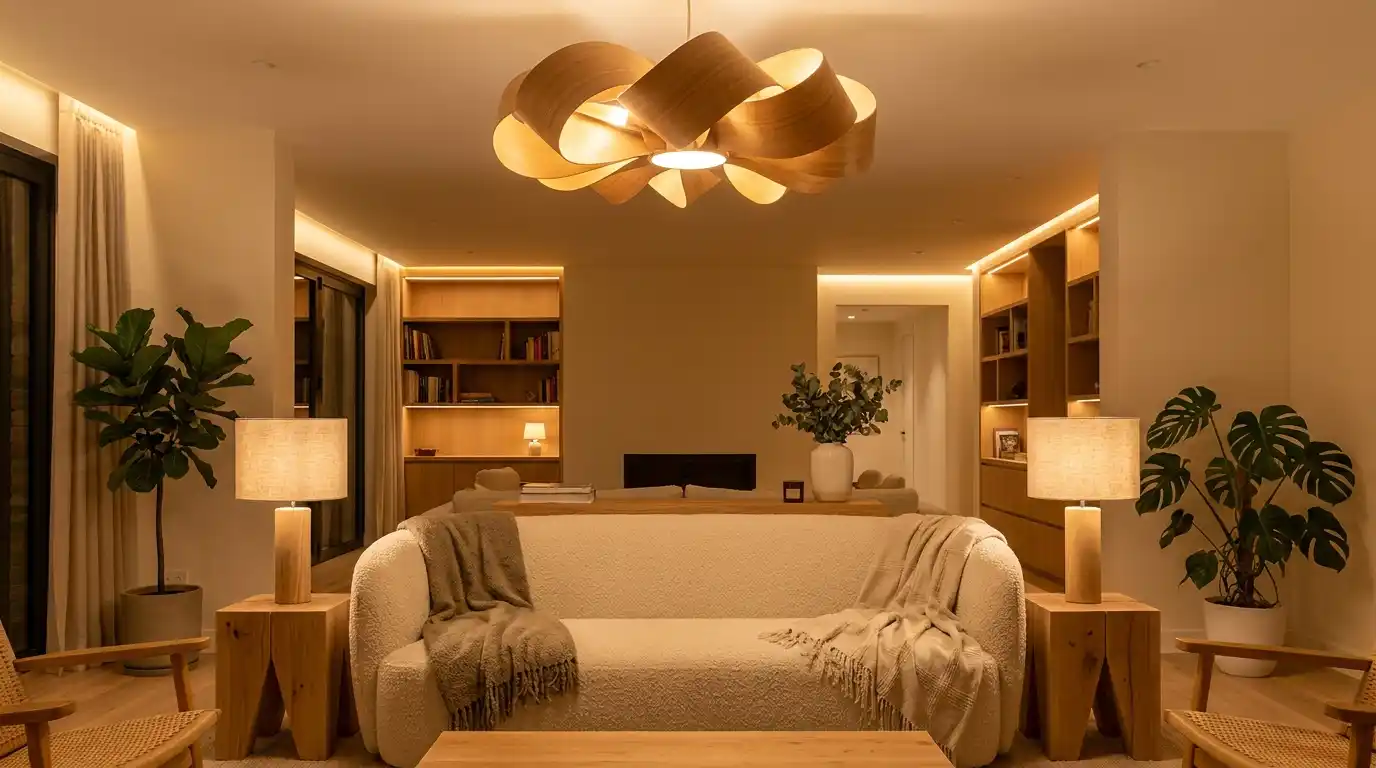
What trips people up in living rooms is relying on a single overhead fixture. One central ceiling light creates flat, shadowless illumination that most people find slightly harsh without knowing why. The better approach is layered lighting — a central fixture for general brightness, table lamps for warmth and task lighting, and perhaps a floor lamp in a reading corner. The total lumen output stays the same; it’s just distributed more naturally.
Color temperature tip: Living rooms benefit from warm white bulbs in the 2700K–3000K range. That’s the golden-toned light that feels like late afternoon sun rather than the blueish-white you find in offices.
Bedroom — Soft and Forgiving
Bedrooms need less raw brightness than most people think — and what they do need should be adjustable.
The target is around 10–15 lumens per square foot for general bedroom lighting, but the more important factor is having dimmable options. Overhead lighting at full brightness at 10pm is genuinely counterproductive if you’re trying to signal your brain that it’s time to sleep. Bright blue-white light suppresses melatonin; softer, warmer, dimmer light does the opposite.
A practical setup: a central overhead fixture on a dimmer, plus bedside lamps for reading. The bedside lamps are the workhorses. The overhead light is for getting dressed in the morning.
Color temperature tip: Stick to 2700K–3000K for bedroom bulbs. Avoid “daylight” bulbs (5000K–6500K) in any bedroom fixture unless you’re using the room primarily during the day.
Dining Room — Ambient but Focused
Dining rooms are interesting because the lighting has to do two things at once: it should make people look good (warm, soft, slightly dramatic) but also make food look appetizing.
The target is around 15–20 lumens per square foot. The key distinction from a living room is where the light comes from. A pendant or chandelier positioned directly over the dining table creates a natural focal point and puts the most light exactly where you want it — on the table and the faces around it.
Avoid wall-washing the entire dining room with even overhead lighting. A slightly darker perimeter with a brighter center table actually reads as more intentional and more flattering than uniform brightness throughout.
Color temperature tip: 2700K–3000K, same as the living room. Warm light makes food and people look better. A dining room with cool white lighting has an institutional feeling that undermines the whole point of the space.
Kitchen — Bright and Functional
The kitchen is where you need to be honest with yourself about what you’re actually doing: handling knives, reading labels, checking whether meat is properly cooked, spotting when things have gone bad in the fridge. This is a task environment.
The recommended target is 30–40 lumens per square foot — significantly higher than living or sleeping spaces. And the distribution matters as much as the total. A single overhead fixture in a kitchen almost always creates shadows directly on the countertop where you’re working, because your body blocks the light from above.
Good kitchen lighting uses multiple sources: overhead recessed or track lighting for general brightness, under-cabinet lighting to illuminate counter surfaces directly, and sometimes a pendant over an island if you have one. The under-cabinet lights are frequently the most impactful upgrade a kitchen can get — inexpensive to install, immediately practical.
Color temperature tip: 3000K–4000K works well in kitchens. Slightly cooler than living spaces, which helps with color accuracy when you’re cooking — you want to see your food as it actually is, not under the warm amber glow that flatters everything. Full “daylight” (5000K+) can feel clinical unless you have a very modern, industrial-style kitchen.
Bathroom / Vanity — High Detail, Minimal Shadows
Bathrooms are where poor lighting has the most immediate consequences. Try applying eyeliner or getting a close shave under a single overhead fixture and you’ll understand immediately.
The issue is shadow direction. Light from directly above casts shadows downward under your brow, nose, and chin — exactly the wrong places. The ideal vanity lighting comes from the sides, at roughly face height, to illuminate evenly without shadows.
The lumen target is 40–50 lumens per square foot for bathrooms used as vanity spaces. That sounds like a lot, but bathrooms are usually small, so the total lumen count stays manageable.
For the vanity specifically, Hollywood-style bulb strips around a mirror work so well precisely because they surround the face with light from multiple angles. Alternatively, two sconces mounted at either side of the mirror at eye level achieve the same effect.
Color temperature tip: 3000K–4000K is the range for bathrooms. Warm enough not to feel harsh, cool enough to give you accurate color rendering. Applying foundation under warm amber light and then walking into daylight is the lighting-mismatch problem nobody warned you about.
How the Lighting Calculator Works
The math behind the calculator is straightforward once you know the target:
Square footage = Room Length × Room Width
Total lumens needed = Square footage × Lumens per square foot (by room type)
Number of bulbs = Total lumens ÷ Lumens per bulb
For example, a 15 × 12 kitchen:
Square footage = 15 × 12 = 180 sq ft Target = 35 lumens/sq ft (mid-range for kitchens) Total lumens = 180 × 35 = 6,300 lumens Using 800-lumen bulbs: 6,300 ÷ 800 = ~8 bulbs
That might sound like a lot — and it probably is if you’re thinking of a single ceiling fixture. But spread across recessed lighting, under-cabinet strips, and an island pendant, 8 light points in a kitchen is very reasonable.
Lumens Per Square Foot: Quick Reference Table
| Room Type | Recommended Lumens/sq ft | Notes |
|---|---|---|
| Living Room | 10–20 | Layer sources; use dimmers |
| Bedroom | 10–15 | Prioritize dimmability; warm bulbs |
| Dining Room | 15–20 | Focus light on table, not walls |
| Kitchen | 30–40 | Include task lighting at counters |
| Bathroom / Vanity | 40–50 | Side lighting beats overhead |
| Home Office | 30–40 | Reduces eye strain on screens |
| Hallways | 5–10 | Lower ambient is fine |
| Garage / Workshop | 40–50 | Functional visibility is the priority |
Understanding Color Temperature (Kelvin)
Lumens tell you how bright. Kelvin (K) tells you what color that brightness is. Both matter.
2700K — Warm White: The classic incandescent tone. Golden, cozy, flattering. Best for bedrooms, living rooms, dining rooms.
3000K — Soft White: Slightly crisper than 2700K but still warm. Works well across most rooms, including kitchens and bathrooms where you want functional light without harshness. A solid all-purpose choice.
3500K–4000K — Cool White / Neutral White: Noticeably crisper and more “awake.” Good for kitchens, bathrooms, and home offices. Some people find this range harsh in living spaces; others prefer it.
5000K–6500K — Daylight: Replicates natural midday sunlight. Great for garages, workshops, laundry rooms, or anywhere you need maximum visibility. Often too clinical for living or sleeping areas.
A quick rule of thumb: the more a room is for relaxing, the warmer (lower K) the bulbs should be. The more a room is for focused tasks, the cooler (higher K) you can go.
How Many Bulbs Do You Actually Need?
This is where the calculator earns its keep. Most people are working with fixtures that have already been installed, so the question becomes: what bulbs, and how many sources?
A few practical scenarios:
Single ceiling fixture: If you only have one light in a room, you’re somewhat limited. Use the highest-lumen bulb that fits the fixture safely (check the max wattage label), then supplement with floor or table lamps to hit your total.
Recessed lighting: Recessed (or “can”) lights typically take 650–800 lumen bulbs. A 12 × 15 living room needing 3,000 lumens total at 800 lumens per bulb needs roughly 4 recessed lights — which is about what most builders put in that size room.
Track lighting: Track setups are flexible because you can add or reposition heads. Great for kitchens and offices where you want to direct light at specific surfaces.
Under-cabinet lighting: These don’t contribute to the room’s general lumen count in a meaningful way — they’re task-specific. Budget them separately from your ceiling lighting.
Common Lighting Mistakes and How to Fix Them
The room feels dim even with enough bulbs. Check the Kelvin rating. A warm 2700K bulb can feel noticeably dimmer than a 4000K bulb with the exact same lumen output, because the warm tone is perceived as softer. You’re not short on lumens — you might just need to bump up slightly or add a lamp.
One corner is always dark. Light follows the inverse square law — it drops off fast with distance. A single central fixture lights the center of a room well and the corners poorly. Add a floor lamp in problem corners rather than switching to a brighter central bulb.
The bathroom mirror is useless for getting ready. Overhead-only lighting. Add side sconces or a mirror with built-in edge lighting. This single change genuinely transforms a bathroom.
The kitchen feels bright but work feels hard. You have overhead lighting but no task lighting. Under-cabinet LEDs are cheap, easy to install, and make an immediate difference. This is probably the most commonly overlooked kitchen upgrade.
The living room feels harsh. You’re likely relying on a single overhead fixture with a cool or neutral Kelvin bulb. Swap to warm white (2700K), put it on a dimmer, and add a table lamp or two. Totally different room.
Energy Costs: LED vs. Incandescent vs. CFL
Since we’re talking about bulbs, it’s worth knowing what your lighting choices actually cost to run.
| Bulb Type | Typical Wattage (800 lm) | Annual Cost (3hrs/day) | Lifespan |
|---|---|---|---|
| Incandescent | 60W | ~$7.88 | 1,000 hrs |
| CFL | 13–15W | ~$1.75 | 8,000 hrs |
| LED | 8–10W | ~$1.05 | 15,000–25,000 hrs |
Numbers based on average US electricity rate of ~$0.12/kWh. Running 8 incandescent bulbs in a kitchen costs roughly $63/year in electricity alone. The same setup with LEDs runs about $8. The LEDs also last 15–25 times longer, so you’re not replacing them constantly.
If you’re still running incandescent or older CFL bulbs anywhere in your house, switching to LEDs is one of the few home upgrades that genuinely pays for itself within a year.
Frequently Asked Questions
Does the calculator account for natural light? No — it calculates artificial lighting needs for the room as if it’s nighttime or the blinds are closed. If your room gets significant natural light during the day, you may find the recommended setup feels bright in the evening but comfortable during daylight hours. That’s actually ideal, and adding dimmers solves any overly-lit feeling at night.
What if my room has an unusual shape? Use length × width for a rough square footage estimate, then adjust slightly downward if there are large cutouts, or upward if there are additional alcoves or nooks you want well-lit.
Can I use one bulb type for the whole house? You can, but 3000K soft white is the closest thing to a universal option that works reasonably well across most rooms. Dedicated spaces — bedrooms, bathrooms, kitchens — will benefit from more tailored choices.
What does CRI mean and should I care? CRI (Color Rendering Index) measures how accurately a light source renders colors compared to natural sunlight, on a scale of 0–100. For most home use, a CRI of 80+ is fine. For vanity bathrooms, art display, or anywhere color accuracy matters, look for CRI 90+.
Should I use smart bulbs? Smart bulbs (like Philips Hue or LIFX) let you adjust both brightness and color temperature from an app or voice command. They’re genuinely useful in living rooms and bedrooms where you want flexibility. For a kitchen or bathroom, the added cost is rarely worth it unless you’re a tech enthusiast.
How do I calculate lumens for a ceiling fan with a light kit? Same math — just factor in that ceiling fan light kits often have lower max wattage limits than standard ceiling fixtures. Check the kit’s maximum bulb wattage and calculate your available lumens from there. Supplement with floor or table lamps if the fan kit can’t hit your target.