
How to Decorate a Half Bathroom From Scratch

Half bathrooms used to be forgotten spaces. Neutral walls. Basic fixtures. Nothing you’d remember or talk about.
That’s changing in 2026.
Your half bathroom can be a moment guests remember. A space where bold choices actually work because you’re only there for a few minutes, but the impact stays with you.
Whether your half bathroom is a guest space near the living area, a powder room, or that small bathroom tucked away—this guide shows you how to decorate it from scratch with intention and style.
Here’s what you’ll learn in the next few minutes:
The 5 foundational decisions that separate memorable spaces from forgotten ones. Which 2026 design trends actually work in compact spaces (hint: bold choices are better than you think).
Budget-friendly strategies whether you have $500 or $3,000 to spend. A step-by-step process from a bare room to a styled space. Specific products to buy and exactly where to place them.
You don’t need a designer. You don’t need to spend thousands of dollars. You just need to understand how small spaces work—and this guide walks you through it.
Start With The Right Color Palette
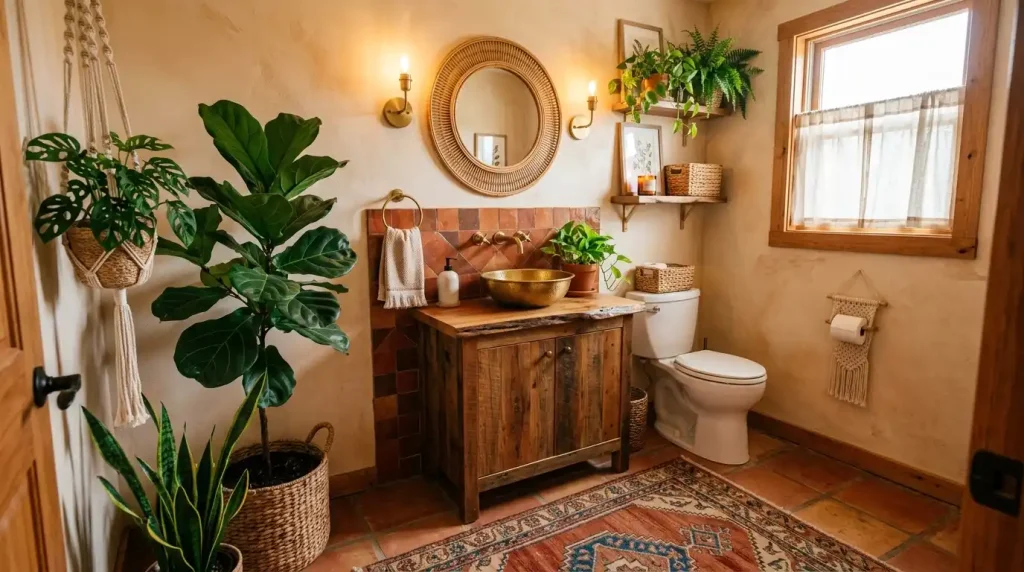
Color choice is your foundation. It determines the mood. It affects how large the space feels. And it influences every single design decision you’ll make after this.
In your half bathroom, color matters more than in any other room of the house. Not because the space is large, but because it’s intimate. You take in the whole room in one glance. That means your color choice affects everything you see.
Here’s what’s trending in 2026: soft pastel shades and earth tones that make you feel calm. Think pale green, dusty blue, warm cream, terracotta, sage, and warm taupe.
These colors “invite relaxation and create a serene atmosphere,” according to design trend experts (Porcelanosa, 2026). They’re not boring. They’re intentional.
You might worry that soft colors are too subtle in a small space. Actually, the opposite is true. Bold color works better in half bathrooms than you’d think. Here’s why: you’re only in the space briefly, but you remember it.
A deep navy wall, rich charcoal, or even burgundy becomes the statement—the moment. You don’t get tired of it because you’re not living with it every day like you would a master bedroom. “In a half bath, that kind of commitment works because you’re only there briefly, but you remember it” (Homedit, 2026).
Real example: muted green walls with creamy wainscoting. The result? A mood that feels calm but memorable. The green feels organic. The cream feels warm. Together, they work.
The monochromatic approach is also trending in 2026. This means using one color family in different shades—light to dark. It’s ideal for small bathrooms because it creates flow instead of visual breaks.
But here’s the honest part: monochromatic can feel boring if you don’t add texture or other elements to break it up. That’s why the next sections matter.
Light colors make spaces feel bigger. That’s real design principle, not marketing speak. But you don’t have to choose light colors. If you want moody and dramatic, go for it. Just understand that darker colors will make the space feel cozier and smaller—which can be exactly what you want.
The key is testing before you commit. Here’s how:
Buy a small sample size of paint. They’re usually $5-7 at any paint store. Paint a 2×2 foot section on your wall. Live with it for a week. See it under morning light, afternoon light, and evening light. Your bathroom lighting changes how colors look. A color that looks perfect at night might feel too dark in the morning. You’ll know within a week if it’s right for you.
Only then do you paint the whole room.
Choose One Statement Element (Not Multiple)
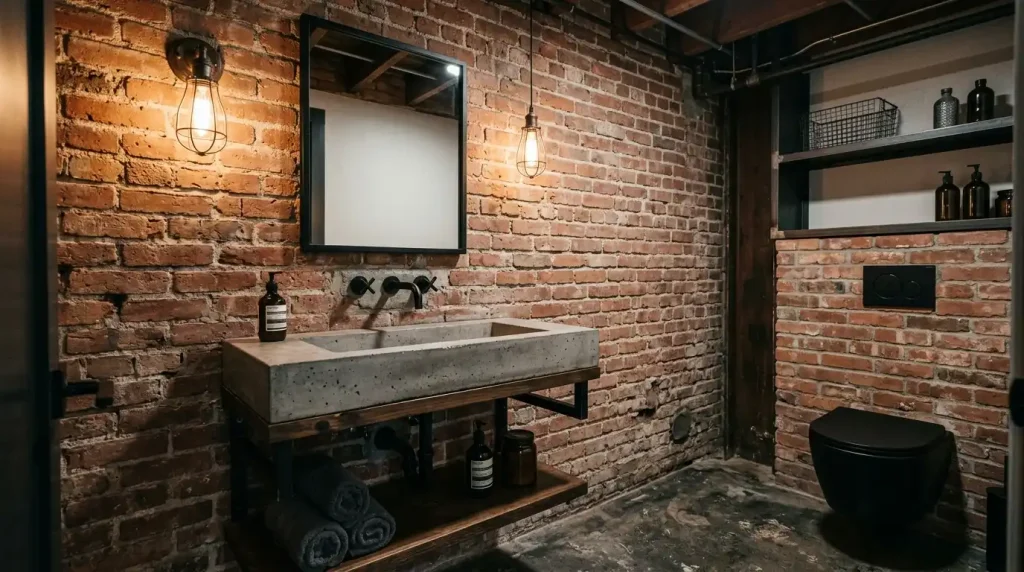
Small bathrooms teach a hard lesson: confidence requires restraint.
In a half bath, your best design strategy is to choose one standout element and let everything else step back to support it. This isn’t about being boring. It’s about creating a moment that lasts.
Why? Because in 30 square feet, every object competes for attention. Too many patterns and textures overwhelm the space immediately.
You look around and feel chaotic, not calm. “Too many patterns and textures can quickly overwhelm the space” (Houzz, 2026). One bold wallpaper and one patterned tile floor create a disjointed, choppy design that doesn’t work.
Here are your statement element options:
- Wallpaper – Creates huge visual impact. Easy to change later. Can feel trendy. Takes 2-4 weeks to install.
- Tile flooring – Sets the entire mood. Durable and hard to change. The highest impact for your money. Takes 1-2 weeks to install.
- Vanity – The first thing guests see. Functional and permanent. Expensive. Takes about 1 week to install.
- Mirror – Reflects light and can be bold. Less transformative than other elements. Easy to swap out. Takes 2-3 days.
- Lighting – Completely changes the mood. Better as a supporting element than the main statement. Takes about 1 week.
How do you choose which one?
Ask yourself: What do I want people to notice first when they open the door?
If you want them to notice the walls, pick wallpaper or color. If you want them to notice the floor, pick patterned tile. If you want them to notice where they’re standing, pick a beautiful vanity.
Real example of this working: The wallpaper becomes the experience. Everything else steps back to support it. “The wallpaper brings softness and movement, while the molding anchors it and keeps the room from feeling busy” (design expert, Homedit 2026). That’s balance. That’s intention.
Here’s what happens to the other elements when you choose your statement piece:
If wallpaper is your statement, your tile should be simple. Your vanity should be clean lines. Your mirror should support the design, not compete with it.
If flooring is your statement, your walls should be neutral. Your vanity can be subtle. Your mirror can be simple.
The statement element carries the design weight. Everything else is supporting cast.
The statement element should be something you won’t tire of quickly. Wallpaper, tile, and vanity are semi-permanent. Mirrors, lighting, and hardware are easier to change. Choose your statement based on what you’re willing to commit to for the next 3-5 years.
Layer The Lighting Strategically
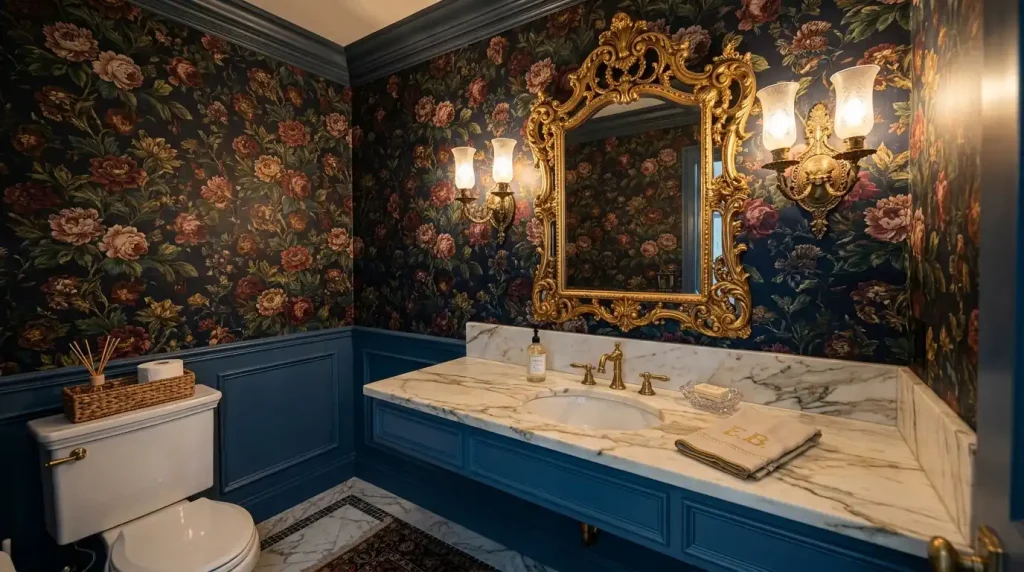
Good lighting is invisible. Until you’re without it.
In a half bath, lighting serves double duty. It has to work for practical tasks like grooming. And it has to make guests feel welcomed and comfortable. The key is layering different light sources to do both.
Three types of lighting work together:
- Task lighting – This is the light over your mirror. It lets you see what you’re doing. It’s bright and functional.
- Ambient lighting – This is the general light in the room. It sets the mood. It makes the space feel intentional instead of institutional.
- Accent lighting – This is the decorative light that adds personality. Wall sconces beside your mirror. A pendant light. A light that’s beautiful AND functional.
“Layered lighting with matching sconces brings a gentle glow that feels flattering and intimate” (real design example, 2026). This is what you’re aiming for.
In 2026, metallic finishes matter as much as the light itself. “Soft, tactile metallic finishes, such as brushed copper, graphite, or bronze, exude warmth and add shine” (Porcelanosa, 2026). These finishes feel warm. They add personality. They elevate your space without being fancy.
Here’s the practical part:
Mount sconces on either side of your mirror, 36-40 inches from the floor. Add recessed lights in the ceiling for general brightness. Add a dimmer switch so you can adjust the mood.
One common mistake: a bathroom with only bright overhead lighting feels cold and institutional. It’s not welcoming. It doesn’t feel intentional.
Another mistake: being too dim. Your guests need to see their faces. Functional and beautiful aren’t opposites.
The color temperature of your bulbs matters. Use 2700K warm white bulbs. This is warm light that makes people look good and feel comfortable. It’s welcoming without being yellow. Never use 4000K or higher—that’s too harsh for a small intimate space.
Think about the mood you want guests to experience. A half bathroom should feel like a small retreat, not a clinical space. That means warm-toned bulbs, multiple light sources, and fixtures that feel elevated instead of basic.
Invest In The Vanity, Flooring, And Mirror
While half bathrooms feel intimate, they’re also highly visible to guests. Three elements create the main visual impression:
What you stand at (your vanity). What you stand on (your flooring). What you look into (your mirror).
These three deserve most of your budget because they’re hard to change later and they determine how the whole space feels.
Let’s talk money first. A complete half bathroom refresh costs between $2,000 and $6,000 in 2026 (Badeloft, 2026). But you’re not doing a full renovation. You’re just decorating. That means you can spend anywhere from $500 to $3,000 depending on your choices.
Here’s how to allocate your budget: Spend 60% on these three elements. Spend the remaining 40% on lighting, accessories, and finishing touches.
The Vanity
Your vanity is the largest visual anchor. It’s also the most functional element. You need counter space and storage.
For half baths, 24-30 inch vanities work best. Smaller looks cheap. Larger looks cramped in a space this size.
Materials matter. Wood tones feel warm and lived-in. Quartz countertops are trending in 2026 because they’re durable, non-porous (no sealing required), and stain-resistant. Granite works too and costs less than marble.
Real example: “Wood tones, patterned tile floors, and a round gold mirror bring together modern farmhouse and subtle boho energy” (2026 design gallery). The warm wood of the vanity anchors the space. It doesn’t have to be expensive. It just has to feel intentional.
Pedestal sinks and wall-mounted sinks free up floor space. That makes the room feel bigger. But they offer zero storage. If you need to keep toiletries accessible, a small vanity with drawers works better.
Your vanity hardware (the handles and knobs) is an easy way to add personality. Brass hardware feels warm and elevated. Matte black feels modern. Polished nickel feels clean and timeless.
The Flooring
“The floor can absolutely be the star” of your half bathroom (design principle, 2026). Flooring sets the entire mood and is durable enough to last.
Patterned tile works well. Geometric patterns, subtle designs, even bold colors. Here’s a pro tip: “The same patterned tile runs across the floor and into the shower wall, removing visual breaks that would normally divide the space” (design strategy, Homedit 2026). Visual continuity makes the space feel larger.
Simple tile works too. Let your other elements be the statement.
Durable porcelain or ceramic tile works in bathrooms because they handle moisture. They last. They look good for years.
The flooring is what you see the most often—it’s the base of everything. Spend enough here to get something you love.
The Mirror
Your mirror does two jobs. It reflects light (making the space brighter). And it can be decorative.
Size matters. Your mirror should be roughly 24-30 inches wide to balance your vanity. Oversized mirrors work in larger bathrooms. In a half bath, they can feel too big.
Frame style adds personality. “Mirrors with gilded frames, shapely scalloped detailing, and sleek modern lines can instantly elevate the look” (2026 design trend). A simple black frame feels modern. A brass-colored frame feels warm. An ornate frame feels traditional.
Framed mirrors cost more than frameless. But they make a bigger design statement.
The Hardware
Here’s what matters: In a small space, cabinet pulls and faucets make or break your design (Houzz, 2026). These details matter because they’re touchpoints. You see them and interact with them.
One 2026 trend is mixing metal finishes. But do it right: Choose one classic metal finish for permanent fixtures (faucets, lighting) like polished nickel or warm brass. Use a secondary finish on hardware, mirrors, and accents.
This prevents your space from feeling disjointed while still looking elevated.
Where to Save Money
You don’t need the most expensive vanity. You need one you like that works functionally.
You don’t need custom tile. Stock tiles are cheaper and still beautiful.
You don’t need professional installation if you’re skilled. But plumbing and electrical should be done by licensed professionals.
Your three major investments create the foundation. Everything else supports these three elements.
Add Finishing Touches Without Overwhelming
At this point, you have your foundation. Your color palette. One statement element. Strategic lighting. Quality major fixtures.
Now comes the temptation to layer on more. Add more plants. More artwork. More accessories. More everything.
Here’s the honest truth: In a 30-square-foot space, every object competes for attention. Your accessories should whisper, not shout.
The principle is simple: less is more in tiny spaces.
Accessory Categories
Think about what goes in your half bathroom in categories:
Functional items (hand towels, soap, trash can). Natural elements (plants, branches, flowers). Decorative items (artwork, wall decor). Textural items (woven elements, wood pieces, ceramic).
“Hand towels and bath accessories are a perfect way to squeeze in visual interest without overdoing it” (Houzz, 2026). A nice hand towel in a complementary color is enough. You don’t need three types of towels.
Styling Open Shelves
If you have floating shelves or open storage, use the rule of thirds: One-third functional items. One-third natural elements like plants or greenery. One-third negative space (empty space).
Empty space is intentional design. It’s not laziness. It’s breathing room.
“A hanging plant by the window adds movement and life, while the black hardware keeps everything anchored” (real example, 2026). One plant. One focal point. Everything else stays simple.
Avoiding Clutter
“Keep powder room decor fairly low key. Less is more” (design best practice, Houzz 2026). This is the rule.
Here’s what this means: You should see your statement element first. You should feel the lighting. You should notice the vanity and flooring. Only after that do you notice accessories.
If accessories compete with your major elements, you’ve added too much.
Seasonal Changes
One smart strategy: Change accessories seasonally. New hand towels for fall. Different artwork for spring. This creates freshness without big investment.
Your core room stays the same. Your color, your statement element, your fixtures—these are stable. But accessories give you flexibility to refresh without painting or redecorating.
Plants especially add life. Green makes any space feel fresher. Biophilic design (bringing nature indoors) is trending in 2026. “To draw a connection with nature, add plants or branches to the space, aligning with the current biophilic design trend” (design principle). Low-light plants work best in bathrooms: pothos, snake plant, ZZ plant.
A hanging plant near the window adds visual interest without taking counter space.
Step back and look at your half bathroom as a whole. You should see your statement element first. Feel the lighting. Notice the vanity and flooring. Only then notice the accessories.
That’s balance. That’s intention. That’s a space worth remembering.
Conclusion
Your half bathroom doesn’t have to be an afterthought anymore.
With a clear color palette, one statement element, strategic lighting, quality major fixtures, and thoughtful accessories, you create a space that guests remember and you enjoy using.
Here’s the process in order:
First, choose your color palette and test it on your wall for a week.
Second, decide on your one statement element—wallpaper, tile, vanity, or mirror.
Third, plan your lighting to be both functional and welcoming.
Fourth, invest in a vanity, flooring, and mirror that you love.
Fifth, add finishing touches with restraint.
The beauty of small spaces is that bold design choices work here. You’re only there briefly, but you remember it. That’s the magic of a well-designed half bathroom.
Start with your color choice this week. Paint that sample. Live with it. Everything else will follow naturally from that one decision.
Your half bathroom deserves intention. Now you have the framework to make it happen.